

Blogs
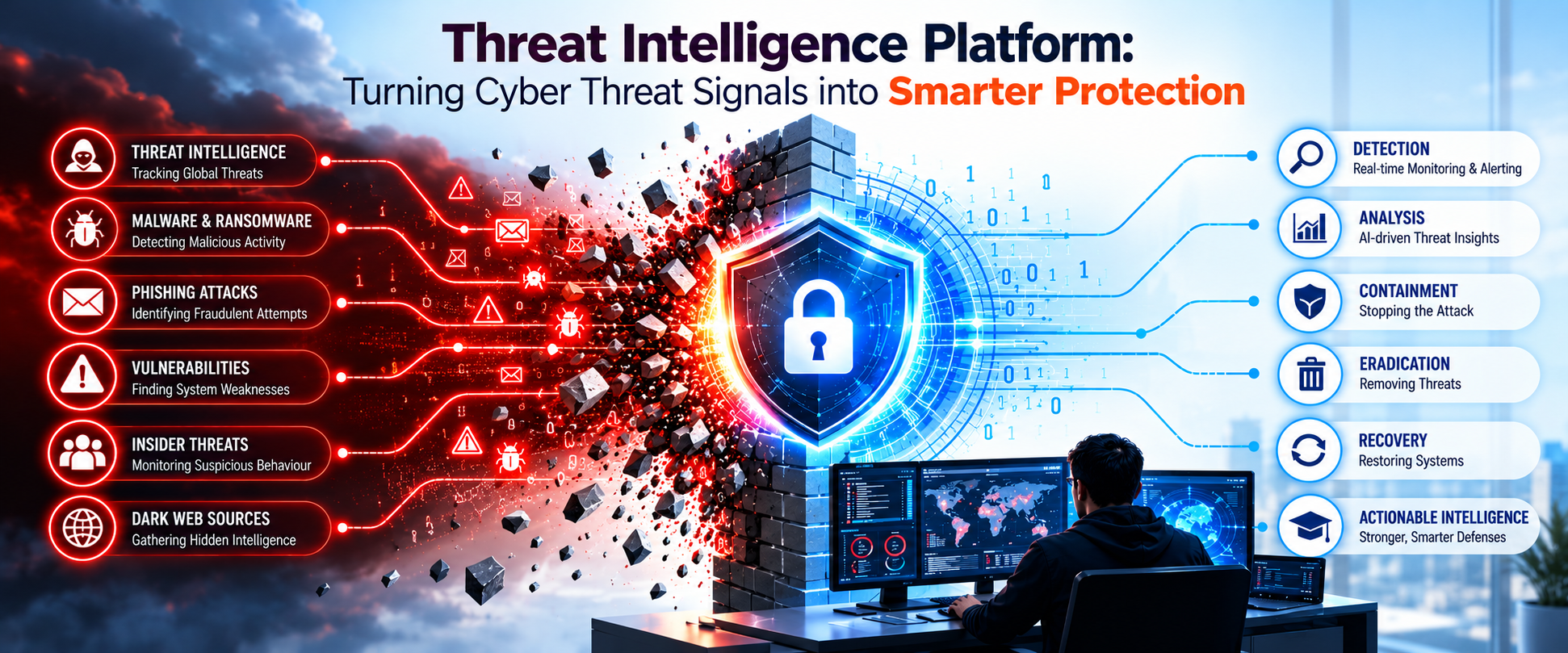
Threat Intelligence Platform: Turning Cyber Threat Signals into Smarter Protection
Cybercrime rarely begins with something that looks obviously dangerous. It begins with a message, a convincing website, an urgent payment request, or a document that appears routine. By the time the deception becomes clear, a password may already be compromised, money transferred, or malicious software installed. The challenge is not detecting threats. It is recognizing risk early enough to make a better decision.
That is where threat intelligence matters. It connects information about suspicious activity with the context needed to understand and respond to it. For Arista, this is central to a cybersecurity proposition: helping people recognize digital danger without requiring them to become security specialists. This blog explores the Arista Threat Intelligence Platform through that lens, connecting Arista Cyber Cop's published positioning with the principles that make intelligence useful in practice.
Why Cybersecurity Needs More Than a List of Known Threats
Known threat databases remain important. A recognized malicious domain, suspicious file signature, or previously identified attack pattern can provide valuable warning. However, attackers constantly change their infrastructure, language, and delivery methods. A fraudulent website can disappear and return under a different address. A familiar scam can arrive through a new channel. A convincing message may contain no malware at all.
Modern protection therefore needs complementary layers: reputation information, behavioural assessment, contextual analysis, and human judgement. Threat intelligence helps these layers work together. Rather than asking only whether something has been seen before, it asks what the available evidence means now. Is the destination associated with harmful activity? Does the request fit an impersonation pattern? What action would reduce exposure? The answers must remain proportionate to the evidence.
What a Threat Intelligence Platform Actually Does
A threat intelligence platform is best understood as a decision support layer, not merely a dashboard displaying alarming numbers. In general, such platforms organize security information, assess its relevance, and make findings usable. Raw indicators become more valuable when accompanied by context: where they came from, when they were observed, how reliable they are, and why they matter.
Consider a suspicious domain. Its presence in a report does not automatically justify treating every interaction as malicious. Analysts need to understand the evidence, possible legitimate uses, and whether the information remains current. Good intelligence preserves uncertainty instead of hiding it. For Arista, the useful framing is straightforward: intelligence should support clearer warnings and safer choices, rather than overwhelm users with unexplained technical signals.
Understanding Arista's Predictive, Preventive, and Proactive Approach
Arista Cyber Cop's public website describes its Advanced Threat Protection approach through three connected ideas: predictive, preventive, and proactive protection. It presents inference AI as a way to study behaviour patterns and identify early warning signals. It also describes monitoring, risk alerts, and actions intended to reduce exposure to suspicious links, files, and activity. These are published product descriptions, not independent performance findings.
The three ideas provide a useful structure for understanding the role of threat intelligence. Predictive means looking for evidence that deserves attention before harm becomes obvious. Preventive means using that evidence to support protective action. Proactive means maintaining awareness as circumstances change. None means predicting every attack or guaranteeing safety. Their value depends on implementation, current information, appropriate permissions, and the quality of the resulting decisions.
Predictive Intelligence: Recognizing Warning Signs Earlier
The word "predictive" can sound like a promise to know the future. In cybersecurity, a more realistic interpretation is early risk recognition. Attackers often leave clues: an unexpected destination, an unusual request, a suspicious sequence of events, or behaviour inconsistent with the activity a user intended. Individually, these clues may be inconclusive. Together, they can justify caution.
Imagine receiving a message claiming that your bank account will be suspended unless you immediately update your details. The branding may look familiar, but the destination may not match the bank's official website. Threat intelligence can help assess the destination, while contextual guidance explains the pressure tactic. The practical outcome is not certainty about every message. It is a better opportunity to pause, verify independently, and avoid unnecessary exposure.
Preventive Intelligence: Making Warnings Useful
A warning delivers value only when it helps someone act. "Potential threat detected" may be technically accurate but practically incomplete. People need to understand what raised concern, what could happen, and what they should do next. Arista's published emphasis on simple explanations is relevant here: the communication surrounding a detection can be as important as the detection itself.
For a suspicious website, useful guidance might recommend leaving the page and opening the organization's official app. For an unexpected document, it might advise confirming the sender before opening attachments or enabling active content. Available blocking or isolation actions depend on the product version and operating environment. Intelligence should guide those actions without presenting an uncertain signal as a definitive accusation or encouraging users to bypass legitimate security controls.
Proactive Intelligence: Keeping Context Current
Cyber risk changes over time. A previously legitimate website can be compromised, an attacker can abandon a domain, and an indicator can become outdated. Intelligence therefore needs a lifecycle. Collection alone is insufficient; information must be reviewed, refreshed, and, where appropriate, retired. Otherwise, yesterday's useful warning can become today's unnecessary disruption.
This is why continuous monitoring must mean more than generating a constant stream of notifications. The objective is to notice meaningful changes and communicate them appropriately. Arista's proactive positioning fits this broader requirement, but the effectiveness of any deployment depends on what is monitored and how updates are handled. Users should understand when protection relies on connectivity and should not assume that online reputation services remain fully available while a device is offline.
Bringing Intelligence Closer to Everyday Digital Decisions
Threat intelligence is often discussed in the language of security operations centres. Yet many consequential decisions happen outside those environments: a parent opens a school notice, an employee receives a supplier invoice, or a small business owner scans a payment code. Protection becomes more useful when relevant intelligence reaches people at these everyday decision points.
Arista's public materials describe areas including phishing links, suspicious files, QR scanning, document verification, and network activity. These categories illustrate how varied the attack surface has become. However, capabilities should not be assumed identical across Windows, Android, and iOS. Operating systems impose different permissions and restrictions. The right question is not whether a product lists a feature, but what that feature actually checks on the device being used.
Why India's Digital Context Matters
India's digital economy brings exceptional convenience through online payments, mobile services, digital public infrastructure, and increasingly connected businesses. It also creates opportunities for deception built around familiar local experiences: KYC requests, courier issues, job offers, investment opportunities, and impersonation of trusted institutions. Effective cybersecurity communication needs to reflect how people encounter these situations.
For an India-focused platform, relevance means more than displaying local branding. It means explaining risks in accessible language, recognizing common fraud narratives, and recommending practical verification steps. A suspicious payment request should trigger caution, not an assumption that a displayed name proves identity. Similarly, reading a QR code reveals its contents; it does not independently establish that the recipient is trustworthy. Threat intelligence strengthens judgement when those boundaries are made clear.
AI Adds Value When Its Reasoning Supports Action
Artificial intelligence can help analyze patterns and organize complex security information. Arista describes its approach using inference AI, with an emphasis on unusual behaviour rather than reliance solely on known patterns. The relevant question for users is not whether AI appears in the description. It is whether the resulting assessment is useful, understandable, and sufficiently reliable for the action proposed.
Every assessment system can produce mistakes. A legitimate activity may be flagged, while a harmful activity may escape detection. Responsible deployment therefore requires feedback, review, and sensible handling of uncertainty. Stronger action should require stronger evidence, especially where business operations could be interrupted. AI should assist investigation and decision making, not replace accountability. An unexplained score is less valuable than a clear explanation paired with an appropriate next step.
Privacy Is Part of the Intelligence Design
Security products occupy a sensitive position because they may observe information about devices, connections, or user activity. A privacy-conscious approach must therefore explain what information is processed locally, what reaches external systems, why it is needed, and how long it is retained. Marketing language alone cannot answer those questions; technical documentation and observable behaviour matter.
Arista's website uses privacy-focused positioning. For any specific deployment, that positioning should be assessed against documented data flows and actual configuration. Even a domain lookup can reveal something about browsing interests when combined with identifiers or timestamps. Organizations evaluating threat intelligence should examine data minimization, access controls, retention, and deletion arrangements. Better protection should be pursued with proportionate information processing, rather than an assumption that collecting more data is always better.
From Individual Safety to Organizational Resilience
For individuals, intelligence should simplify a decision: proceed cautiously, verify independently, or stop. Organizations need additional context. A suspicious link received by one employee may warrant awareness; the same link appearing across several teams may justify a coordinated investigation. Connecting such observations can help security teams understand exposure, prioritize work, and communicate more effectively with affected users.
These are broader organizational use cases for threat intelligence, not confirmation that every enterprise workflow is available in Arista today. Buyers should verify reporting, administrative controls, integrations, evidence export, and response options through current documentation and demonstrations. A consumer protection application and a full enterprise intelligence platform serve related but different requirements. Clear scope helps organizations select the right solution and avoids expecting capabilities that have not been established.
Measuring What Matters
The value of threat intelligence should not be measured only by the size of a database or the number of alerts generated. Large volumes can conceal poor relevance. More meaningful measures include the usefulness of warnings, the time needed to investigate a concern, the frequency of incorrect alerts, and whether users understand the recommended response.
An evaluation of Arista should therefore use representative, controlled scenarios and record both successful detections and limitations. Reviewers should test relevant devices, versions, and connectivity conditions rather than extrapolate from a single demonstration. They should also examine usability: can a person explain why a warning appeared and identify the next safe action? Meaningful assurance comes from repeatable evidence, transparent limitations, and continued improvement, not absolute claims about stopping every threat.
Building a Stronger Human Layer
Technology is only one part of resilience. People still need habits that reduce opportunity for attackers: checking unexpected requests, using strong authentication, keeping software updated, and reporting suspicious activity promptly. Threat intelligence becomes more valuable when it reinforces these habits instead of encouraging dependence on a reassuring status indicator.
Arista's emphasis on clear alerts creates an opportunity to make protection educational. A well-designed explanation can teach someone why an urgent request is suspicious or why a familiar logo is not proof of authenticity. Over time, those lessons can improve decisions beyond the application itself. The goal should be confidence grounded in understanding, not the belief that any tool makes verification unnecessary. Security works best when people and technology strengthen each other.
Conclusion: Better Intelligence, Better Decisions
The promise of the Arista Threat Intelligence Platform is most meaningful when expressed as a practical ambition: turning relevant threat signals into understandable guidance and timely protective action. Arista Cyber Cop's predictive, preventive, and proactive positioning offers a useful way to communicate that ambition, while keeping attention on everyday risks rather than technical complexity.
Ultimately, intelligence earns trust through relevance, transparency, and evidence. Users need to know what is being assessed, what a warning means, and where limitations remain. Organizations need documented capabilities that match their operational requirements. Across both settings, the objective is the same: fewer avoidable mistakes, better informed responses, and a stronger foundation for digital trust. Explore Arista's published product information at AristaCyberCop.com and assess the available version against your specific needs.