

Blogs
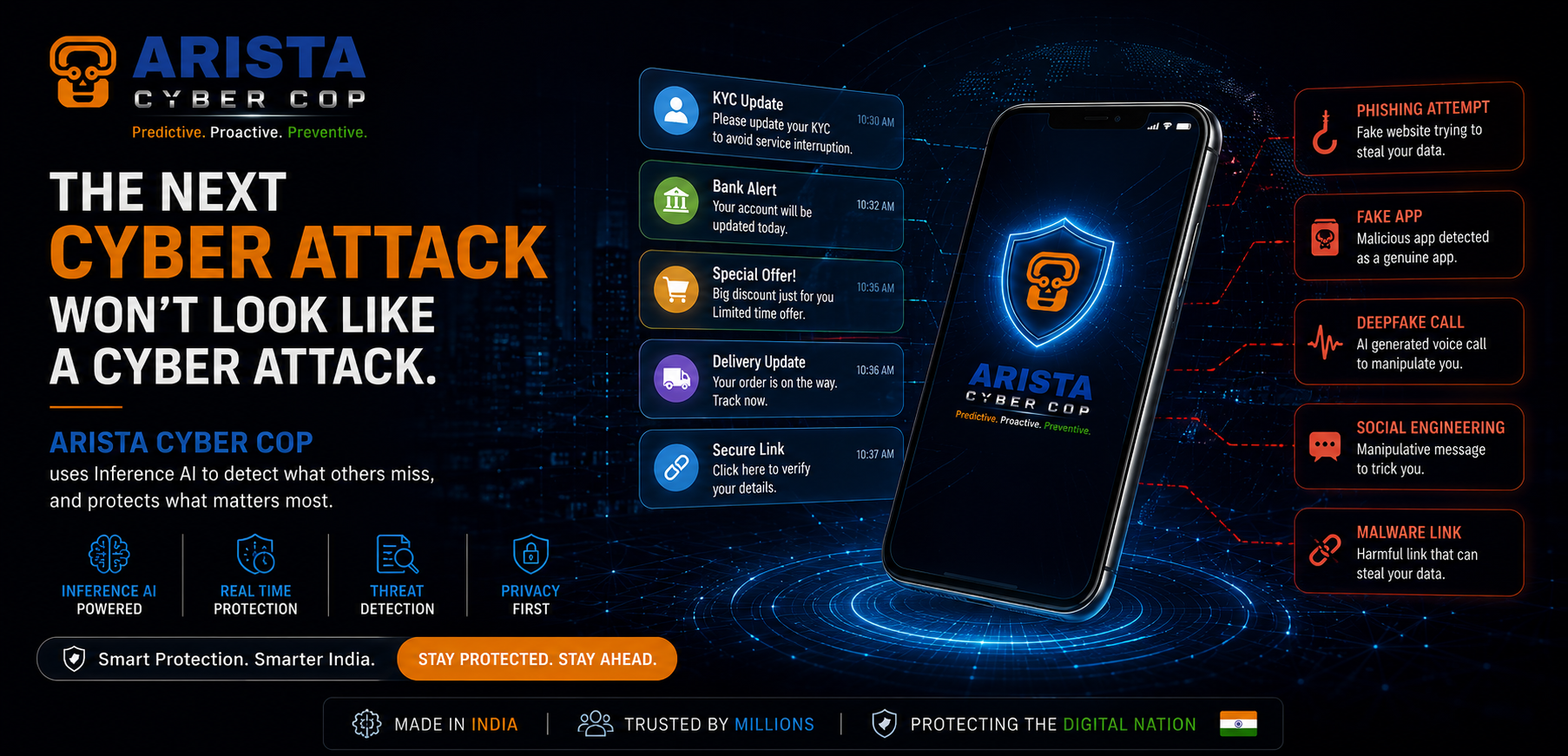
Enhancing Cybersecurity with Advanced Threat Detection Systems
The Next Cyber Attack Won't Look Like a Cyber Attack
Predictive. Proactive. Preventive.
For decades, the word cyberattack has created a familiar image in our minds. A hacker breaking into a server. A computer infected with malware. A ransomware screen demanding payment. A suspicious email carrying a malicious attachment.
Cybersecurity was built around identifying these technical threats, blocking them, and responding when something went wrong.
But the nature of cybercrime is changing.
The next major cyberattack may not begin with malware. It may begin with a phone call. It may arrive as a WhatsApp message from someone who appears to be your friend. It may be an email that looks exactly like it came from your bank, employer, client, or government department. It may be a website that looks completely legitimate. It may be a QR code, a fake customer-care number, an investment opportunity, a job offer, or even a video call featuring an AI-generated version of someone you trust.
There may be no obvious warning.
No flashing red screen. No suspicious attachment. No technical vulnerability for a traditional security tool to detect. Because the next cyberattack may not attack your technology first. It may attack your trust.
The Cyber Threat Has Changed
The digital world has changed dramatically. A few years ago, cybercriminals often needed considerable technical expertise to compromise a target. Today, technology has lowered the barrier to entry.
Artificial intelligence, automation, social media, publicly available information, and sophisticated digital tools have made it easier for criminals to research targets, impersonate people, create convincing content, and operate at scale.
A criminal does not necessarily need to break into your computer if they can convince you to give them access. They don't necessarily need to steal your password if they can persuade you to enter it on a fake website. They don't necessarily need to compromise your bank if they can manipulate you into authorising a transaction yourself.
This represents a fundamental shift.
The attack surface is no longer limited to devices, networks and applications. The attack surface increasingly includes human behaviour. And that changes the cybersecurity problem completely.
When an Attack Looks Normal
Imagine receiving a message from your company's finance head: "Please process this payment urgently. I'm in a meeting and will call you later."
The name is correct. The profile picture is correct. The language sounds familiar. The urgency makes sense. You make the payment.
Only later do you discover that the account was compromised—or that the message was generated as part of a carefully planned impersonation attack.
Technically, your computer may have been perfectly secure. Your antivirus may have worked perfectly. Your firewall may have worked perfectly. Your operating system may have been fully updated.
Yet the attack succeeded.
Why? Because the attacker did not need to defeat your security system. They defeated your confidence.
This is the new reality of cybercrime.
The New Weapon Is Trust
Trust is one of the most valuable assets in the digital economy.
- We trust an email because it appears to come from a known organisation.
- We trust a website because it has the right logo.
- We trust a caller because they know our name.
- We trust a message because it comes from a familiar profile.
- We trust a video because we can see the person speaking.
- We trust a payment request because it appears to come from someone we know.
Cybercriminals understand this psychology. They don't always need to create something obviously suspicious. Their objective is often the opposite: make the malicious interaction look ordinary.
This is why modern cybercrime is increasingly becoming a problem of digital trust.
The critical question is no longer simply: "Is this device secure?"
It is also: "Can I trust what I am seeing, receiving, clicking, communicating with or being asked to do?"
That is a much harder problem.
AI Has Changed the Equation
Artificial intelligence is transforming almost every industry. Unfortunately, cybercrime is no exception.
AI can help legitimate organisations detect threats with advanced threat detection systems, analyse enormous amounts of data and respond faster. But the same technology can also be misused by attackers.
- Messages can become more convincing.
- Fake websites can become more realistic.
- Social engineering can become more personalised.
- Voice and video impersonation can become more sophisticated.
- Attackers can analyse publicly available information about a person and use it to construct highly targeted approaches.
The old assumption that "a scam will be easy to recognise because it contains spelling mistakes or looks unprofessional" is becoming increasingly unreliable.
A malicious message can now look polished. A fake website can look professional. A fraudulent conversation can feel natural. A synthetic voice can sound familiar.
And that means human intuition alone cannot remain our primary line of defence.
Why Traditional Cybersecurity Isn't Enough
Traditional cybersecurity remains essential. Firewalls, endpoint protection, identity management, encryption, vulnerability management, real-time threat intelligence, and network security are fundamental components of modern digital defence.
But they were largely designed around a particular model: Identify a known or detectable threat → block it → respond to the incident.
The emerging threat environment demands something more.
- What happens when the threat is not yet a known malware signature?
- What happens when there is no malicious file?
- What happens when the user willingly clicks the link?
- What happens when the website is technically functioning exactly as designed—but its purpose is fraudulent?
- What happens when a legitimate communication channel is being used for an illegitimate purpose?
These situations require cybersecurity to move beyond simply asking: "Is this malicious?"
It must begin asking: "Does this behaviour indicate danger?"
That distinction is critical.
From Reactive Security to Predictive Cyber Defence
For years, cybersecurity has largely been reactive.
- An attack happens.
- A system generates an alert.
- A security team investigates.
- The organisation responds.
The objective is to minimise damage.
But what if cybersecurity could move further upstream?
- What if signals could be identified before the attack became a successful incident?
- What if suspicious patterns, behaviours, identities, websites, communications and digital activities could be evaluated continuously?
- What if an advanced threat detection system could help determine that something is not necessarily malicious yet—but increasingly risky?
This is the philosophy behind predictive cybersecurity.
Predictive cybersecurity does not mean predicting the exact future with certainty. It means using available intelligence, behavioural signals, contextual information and patterns to identify potential risks before they become major incidents.
The difference may seem subtle. In practice, it can be enormous.
The Future Is Context-Aware Security
Consider a simple example. A person receives a payment request.
A traditional security system may ask: "Is this message malicious?"
A more advanced system can consider a much broader context:
- Who sent the message?
- Is the sender behaving differently from normal?
- Is the destination account unusual?
- Is the request consistent with previous behaviour?
- Is there unusual urgency?
- Has the associated domain recently appeared?
- Is the communication connected to known fraud patterns?
- Is the requested transaction inconsistent with historical activity?
- Are multiple independent signals pointing toward risk?
Individually, each signal may appear insignificant. Together, they may reveal a pattern.
This is where advanced threat detection systems become powerful.
The future of cyber defence will increasingly depend on connecting signals that humans may not recognise as connected.
The Human Being Is the New Attack Surface
There is another uncomfortable reality we need to acknowledge.
Employees are often described as the "weakest link" in cybersecurity. That description is unfair.
People are not inherently weak. They are simply being asked to make increasingly complex security decisions in an environment designed to create trust and urgency.
A person may receive hundreds of legitimate messages every day. They may be expected to respond quickly. They may work remotely. They may communicate across email, WhatsApp, collaboration platforms, websites, mobile applications and video calls.
Expecting every individual to independently identify sophisticated digital deception is unrealistic.
Cybersecurity therefore needs to evolve from "train the user not to make mistakes" to "build systems that help users make safer decisions."
The objective should not be to blame people after an incident. It should be to protect them before the incident happens.
Cybersecurity Must Become Preventive
There is a fundamental difference between detecting an attack and preventing one.
- Detection asks: "What is happening?"
- Response asks: "What should we do now?"
- Prevention asks: "How do we stop this from happening?"
Predictive defence goes one step further: "What signals suggest that something dangerous may happen next?"
This is the direction in which cybersecurity needs an advanced threat detection system.
And it is particularly important for a country like India.
India's Digital Future Needs a New Cybersecurity Philosophy
India is experiencing one of the world's most significant digital transformations. Digital payments, online banking, e-commerce, digital governance, connected businesses, cloud platforms and smartphones have fundamentally changed how people interact with the economy.
This transformation creates enormous opportunities.
But every increase in digital adoption also increases the importance of digital trust.
If people stop trusting online payments, digital platforms, websites, applications or communications, the cost is not merely financial. It affects confidence in the digital economy itself.
Therefore, cybersecurity should not be viewed merely as an IT department's responsibility. It is becoming an essential part of digital infrastructure.
A digitally empowered society must also be a digitally protected society.
Therefore, it's necessary to use advanced threat detection systems.
Made in India. Protecting the World.
India has traditionally been recognised as a global technology and software powerhouse. The next opportunity is bigger.
India can build technologies that don't just participate in the digital economy—but help protect it.
This is the vision behind Arista Cyber Cop.
Built around the philosophy of Predictive. Proactive. Preventive. Arista's Advanced Threat Defense provides a proactive approach to cybersecurity: from simply responding to known threats to understanding emerging risks, behavioural patterns, and the broader context surrounding digital interactions.
The goal is not to create another tool that produces more alerts. The goal is to help create a safer digital environment where technology can identify risk earlier, provide meaningful intelligence and support better decisions.
Because cybersecurity should ultimately be measured not by how many alerts a system generates, but by how effectively it helps prevent harm.
The Next Attack May Be Invisible
The most dangerous cyberattack may not trigger an alarm.
- It may look like an ordinary conversation.
- It may look like an ordinary email.
- It may look like a normal website.
- It may sound like a familiar voice.
- It may appear to come from someone you trust.
And that is precisely why the cybersecurity industry must change.
The future cannot depend entirely on recognising yesterday's threats. We need an advanced threat protection solution capable of understanding behaviour, context, patterns, and emerging signals.
We need an advanced threat detection system that does not simply wait for something bad to happen.
We need cybersecurity that asks what could happen next.
The future belongs to security that can see beyond the attack itself.
The Real Question
The question facing organisations, governments and individuals is no longer simply: "Are we protected against cyberattacks?"
A better question is: "Can we recognise risk before it becomes an attack?"
That is the transition from reactive cybersecurity to predictive cyber defence.
- From detection to anticipation.
- From response to prevention.
- From protecting machines to protecting people, identities, businesses, and trust with an advanced threat detection system.
The next cyberattack may not look like a cyberattack.
It may look completely normal.
And by the time it looks dangerous, it may already be too late.
That is why the future of cybersecurity must begin before the attack.
Arista Cyber Cop
Predictive. Proactive. Preventive.
Made in India. Protecting the World.